DemoYou're exploring a demo: a real video, already processed by echoflow. Read-only, no signup needed.Expand the cards to see what echoflow generates. It's all in the 14-day trial, except what's marked «Pro».Expand the cards: what's marked «Pro» isn't in the trial.
From one video: transcript, posts, article, clips and images
5 habits to focus and get more done.mp4
Completed
Duration
5m 04s
Minutes
6
Steps
23 / 23
Uploaded
1 Nov 2026, 09:05
Downloads, chat and support are off in the demo — they work with your account.
Type
No threat found in the source file.
audio.mp3 · 5:04
Do you feel like you work all day and reach the evening without finishing anything important? You are not short on time. You are short on attention. In this video I will share 5 practical habits to really focus and get more done. Working fewer hours but better. For each one I will give you a practical example you can try tomorrow. You do not need apps or expensive tools. A sheet of paper, a timer and a bit of consistency are enough. The first habit is to design your environment before relying on willpower. Focus is not a gift, it is the result of what surrounds you. Take your phone off the desk, close the tabs you do not need, prepare everything the evening before. If distraction is within reach, sooner or later you will give in. Make it hard to reach and you will not have to fight it. Here is an example. Before you end your day, leave on your desk only what you need for tomorrow's first task. The document already open. A sheet of paper for notes. A glass of water. Your phone goes in a drawer. Or in another room if you can. The next morning you do not have to decide anything. You sit down and start. Five minutes in the evening are enough. The second habit is to work in deep blocks of 90 minutes. The brain is not built for eight hours of flat attention. It performs much better in intense cycles followed by a break. Pick one single thing. Set a 90 minute timer and protect that block like an appointment you cannot miss. At first 90 minutes may feel like a lot. If you need to, start with 60 and stretch it a little at a time. In practice, put the block in your calendar as if it were a meeting, with a precise title, not work on the project, but write the first draft of the proposal. When the timer goes off you stop, even if you are in the middle of a sentence. Two blocks like this a day are worth more than eight hours of interrupted work. The third habit is to start with the hardest thing. Your mental energy peaks in the morning and drops during the day. If you spend the first hours on email, you use the best part of yourself on tasks anyone could do. Tackle first the thing you are avoiding, the rest of the day becomes downhill. To really do it, write a single line on a sheet of paper the evening before. Tomorrow's hardest thing. Not a list of ten items. One line. In the morning. Before opening your email. You work on that for the first block of the day. If you finish early. Good. The task that weighed the most is already behind you. The fourth habit is to silence notifications and stay in single tasking. Every notification is an invitation to switch context, and every switch costs you minutes to get back on track. It is not multitasking. It is moving badly from one thing to another. Put your phone in another room and turn off the alerts. One thing at a time. All the way through. The first few times you will feel you are missing something. After a few days you will notice that nothing happens. A simple way to start is to give email two fixed windows, one at the end of the morning and one in the middle of the afternoon. Outside those windows your inbox stays closed. If something is truly urgent, whoever needs you will call. The fifth habit is to give yourself real breaks to recover your attention. A break spent scrolling social media recharges nothing. Stand up, move, look into the distance, breathe. Real breaks are what make focus sustainable, not caffeine. Ten minutes between one block and the next are enough. Here is what a real break can look like. You stand up, refill your glass of water, take two flights of stairs or a few steps outside, look at something far away from the window, no phone. After ten minutes you go back to your desk and start the next block with a lighter head. Why do these habits work together? Because they take decisions out of your day, your environment decides instead of your willpower, the block in your calendar decides when you work, the evening list decides where you start, the email windows decide when you reply, fewer decisions mean more energy for the work that matters, and more energy at the end of the day also means more time and a clearer head for the people around you. To sum up, design your environment, work in 90 minute blocks, start with the hardest task, silence notifications and take real breaks, do not try them all at once, pick one and put it into practice tomorrow, then add the next one the following week. Small changes repeated every day are what make the difference. If you found this video useful, subscribe. Next week we will talk about how to say no without feeling guilty.
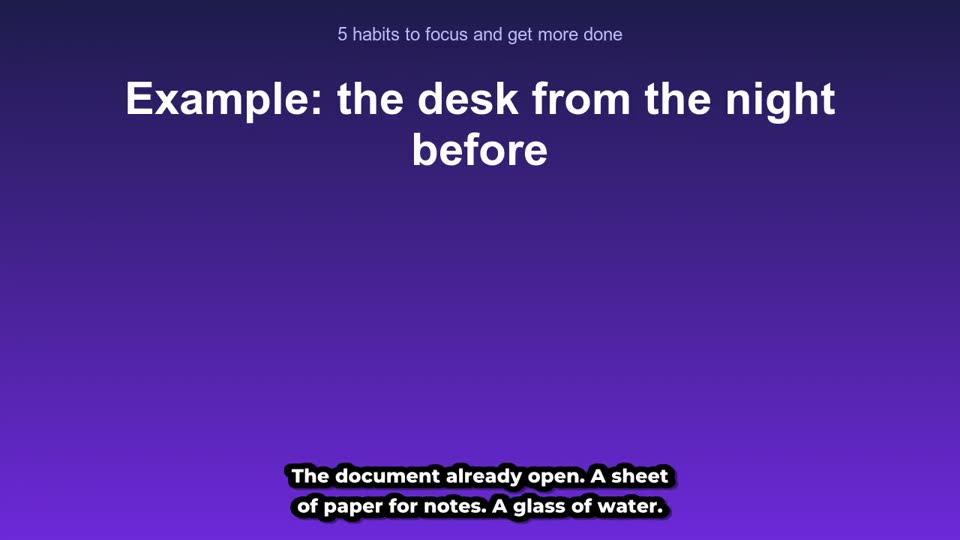
Analysis complete: the AI settled the thesis, key points, keywords and tone of voice of the content, once and for all. There's no text to download — it's the shared outline the summary, social posts, SEO, blog and everything else start from: that's why they all sound alike.
1
00:00:00,000 --> 00:00:02,759
Do you feel like you work
all day and reach the
2
00:00:02,759 --> 00:00:05,400
evening without finishing
anything important?
3
00:00:05,400 --> 00:00:08,946
You are not short on time.
You are short on attention.
4
00:00:08,946 --> 00:00:14,200
In this video I will share 5 practical
habits to really focus and get more done.
5
00:00:14,200 --> 00:00:16,164
Working fewer hours but better.
6
00:00:16,164 --> 00:00:20,600
For each one I will give you a practical
example you can try tomorrow.
7
00:00:20,600 --> 00:00:23,855
You do not need apps or expensive tools.
8
00:00:23,855 --> 00:00:28,900
A sheet of paper, a timer and a
bit of consistency are enough.
9
00:00:28,900 --> 00:00:33,708
The first habit is to design your
environment before relying on willpower.
10
00:00:33,708 --> 00:00:37,606
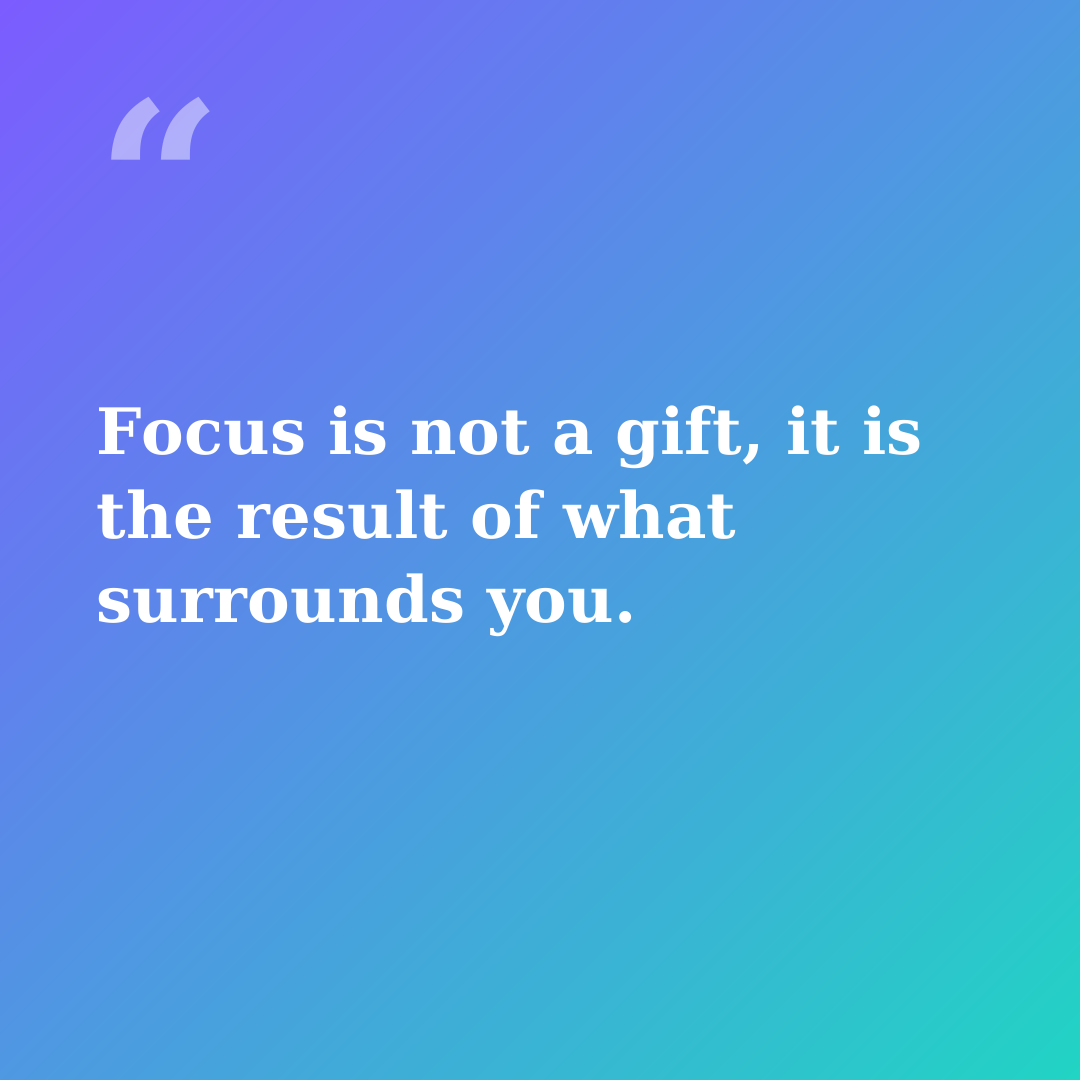
Focus is not a gift, it is the
result of what surrounds you.
11
00:00:37,606 --> 00:00:41,569
Take your phone off the desk,
close the tabs you do not need,
12
00:00:41,569 --> 00:00:46,118
prepare everything the evening before.
If distraction is within reach,
13
00:00:46,118 --> 00:00:48,262
sooner or later you will give in.
14
00:00:48,262 --> 00:00:51,900
Make it hard to reach and you
will not have to fight it.
15
00:00:51,900 --> 00:00:54,883
Here is an example.
Before you end your day,
16
00:00:54,883 --> 00:00:59,222
leave on your desk only what
you need for tomorrow's first task.
17
00:00:59,222 --> 00:01:04,103
The document already open. A sheet
of paper for notes. A glass of water.
18
00:01:04,103 --> 00:01:08,103
Your phone goes in a drawer.
Or in another room if you can.
19
00:01:08,103 --> 00:01:11,629
The next morning you do not
have to decide anything.
20
00:01:11,629 --> 00:01:15,900
You sit down and start. Five
minutes in the evening are enough.
21
00:01:15,900 --> 00:01:18,713
The second habit is to work
in deep blocks of 90 minutes.
22
00:01:18,713 --> 00:01:21,180
The brain is not built
for eight
23
00:01:21,181 --> 00:01:24,334
hours of flat attention.
It performs much better
24
00:01:24,334 --> 00:01:27,421
in intense cycles followed
by a break. Pick one
25
00:01:27,421 --> 00:01:30,381
single thing. Set a 90
minute timer and protect
26
00:01:30,381 --> 00:01:33,341
that block like an appointment
you cannot miss.
27
00:01:33,341 --> 00:01:36,018
At first 90 minutes may feel like a lot.
28
00:01:36,018 --> 00:01:40,301
If you need to, start with 60
and stretch it a little at a time.
29
00:01:40,941 --> 00:01:45,286
In practice, put the block in your
calendar as if it were a meeting,
30
00:01:45,286 --> 00:01:50,334
with a precise title, not work on the
project, but write the first draft of the
31
00:01:50,334 --> 00:01:55,318
proposal. When the timer goes off you
stop, even if you are in the middle of a
32
00:01:55,318 --> 00:01:58,257
sentence. Two blocks
like this a day are worth
33
00:01:58,257 --> 00:02:00,941
more than eight hours of interrupted work.
34
00:02:00,941 --> 00:02:04,271
The third habit is to start
with the hardest thing.
35
00:02:04,271 --> 00:02:08,515
Your mental energy peaks in the
morning and drops during the day.
36
00:02:08,515 --> 00:02:13,804
If you spend the first hours on email,
you use the best part of yourself on tasks
37
00:02:13,804 --> 00:02:17,525
anyone could do. Tackle first
the thing you are avoiding,
38
00:02:17,525 --> 00:02:19,941
the rest of the day becomes downhill.
39
00:02:19,941 --> 00:02:25,125
To really do it, write a single line
on a sheet of paper the evening before.
40
00:02:25,125 --> 00:02:30,309
Tomorrow's hardest thing. Not a list
of ten items. One line. In the morning.
41
00:02:30,309 --> 00:02:35,424
Before opening your email. You work
on that for the first block of the day.
42
00:02:35,424 --> 00:02:40,881
If you finish early. Good. The task that
weighed the most is already behind you.
43
00:02:40,882 --> 00:02:45,564
The fourth habit is to silence
notifications and stay in single tasking.
44
00:02:45,564 --> 00:02:49,076
Every notification is an
invitation to switch context,
45
00:02:49,076 --> 00:02:52,718
and every switch costs
you minutes to get back on track.
46
00:02:52,718 --> 00:02:57,205
It is not multitasking. It is moving
badly from one thing to another.
47
00:02:57,205 --> 00:03:00,782
Put your phone in another
room and turn off the alerts.
48
00:03:00,782 --> 00:03:03,448
One thing at a time. All the way through.
49
00:03:03,448 --> 00:03:07,350
The first few times you will
feel you are missing something.
50
00:03:07,350 --> 00:03:10,862
After a few days you will
notice that nothing happens.
51
00:03:10,882 --> 00:03:14,847
A simple way to start is to give
email two fixed windows,
52
00:03:14,847 --> 00:03:19,647
one at the end of the morning
and one in the middle of the afternoon.
53
00:03:19,647 --> 00:03:22,847
Outside those windows
your inbox stays closed.
54
00:03:22,847 --> 00:03:26,882
If something is truly urgent,
whoever needs you will call.
55
00:03:26,882 --> 00:03:32,259
The fifth habit is to give yourself
real breaks to recover your attention.
56
00:03:32,259 --> 00:03:36,256
A break spent scrolling social
media recharges nothing.
57
00:03:36,256 --> 00:03:39,744
Stand up, move, look into
the distance, breathe.
58
00:03:39,744 --> 00:03:43,958
Real breaks are what make focus
sustainable, not caffeine.
59
00:03:43,958 --> 00:03:47,882
Ten minutes between one block
and the next are enough.
60
00:03:47,882 --> 00:03:50,680
Here is what a real break can look like.
61
00:03:50,680 --> 00:03:55,787
You stand up, refill your glass
of water, take two flights of stairs or a
62
00:03:55,787 --> 00:04:00,823
few steps outside, look at something
far away from the window, no phone.
63
00:04:00,823 --> 00:04:03,720
After ten minutes you go back to your desk
64
00:04:03,720 --> 00:04:06,823
and start the next block
with a lighter head.
65
00:04:06,823 --> 00:04:11,903
Why do these habits work together? Because
they take decisions out of your day,
66
00:04:11,903 --> 00:04:15,182
your environment decides
instead of your willpower,
67
00:04:15,182 --> 00:04:18,333
the block in your calendar
decides when you work,
68
00:04:18,333 --> 00:04:23,606
the evening list decides where you start,
the email windows decide when you reply,
69
00:04:23,606 --> 00:04:27,400
fewer decisions mean more energy
for the work that matters,
70
00:04:27,400 --> 00:04:30,808
and more energy at the end
of the day also means more
71
00:04:30,808 --> 00:04:34,023
time and a clearer head
for the people around you.
72
00:04:34,023 --> 00:04:38,125
To sum up, design your environment,
work in 90 minute blocks,
73
00:04:38,125 --> 00:04:42,966
start with the hardest task, silence
notifications and take real breaks,
74
00:04:42,966 --> 00:04:47,808
do not try them all at once, pick
one and put it into practice tomorrow,
75
00:04:47,808 --> 00:04:52,515
then add the next one the following
week. Small changes repeated every
76
00:04:52,515 --> 00:04:57,625
day are what make the difference.
If you found this video useful, subscribe.
77
00:04:57,625 --> 00:05:02,063
Next week we will talk about
how to say no without feeling guilty.
The problem isn't a shortage of hours but of attention, and the fix is five habits that take the load off willpower. Start by designing the environment the evening before — phone in a drawer, only tomorrow's first task left on the desk — because "Focus is not a gift, it is the result of what surrounds you." Then protect 90-minute blocks with a precise title in the calendar, opening the day with the hardest task while mental energy peaks (start at 60 minutes and stretch if 90 feels long). Notifications go off and email gets two fixed windows, since every context switch costs minutes to get back on track, and breaks mean standing up, moving, looking into the distance and leaving the phone behind. Two blocks a day are worth more than "eight hours of interrupted work," and the habits reinforce each other by removing decisions from the day. Pick one, try it tomorrow, and add the next the following week.
During the trial the video carries the echoflow watermark; on every paid plan it comes out clean.
Primary keyword: focus habits (intent: informational)
Secondary keywords: productivity tips (informational), deep work (informational), time management (informational), deep blocks (informational), single tasking (informational), environment design (informational), mental energy (informational), work-life balance (informational)
SEO title: Focus Habits: 5 Ways to Get More Done in Fewer Hours
Title variants (CTR):
- You're Not Short on Time, You're Short on Attention: 5 Focus Habits
- 5 Focus Habits That Beat Willpower Every Time
Meta description: Five focus habits to get more done in fewer hours: design your environment, work in 90-minute blocks and start with the hardest task.
Tags: focus habits, productivity tips, deep work, time management, deep blocks, single tasking, environment design, mental energy, work-life balance, attention management
00:00 You're not short on time, you're short on attention
00:28 Habit 1: Design your environment
01:15 Habit 2: Work in 90-minute deep blocks
02:00 Habit 3: Start with the hardest task
02:40 Habit 4: Silence notifications and single-task
03:26 Habit 5: Take real, screen-free breaks
04:06 Why the habits work together
04:34 Start with one habit tomorrow
You can work all day and still reach the evening without having finished anything that mattered — not because you lack hours, but because you lack attention. This breakdown gives you five concrete focus habits, each with an example you can try tomorrow, using nothing more than a sheet of paper and a timer.
00:00 — The real bottleneck isn't time, it's attention: working fewer hours but better beats working all day.
00:28 — Habit 1: design your environment before relying on willpower — phone off the desk, unnecessary tabs closed, everything ready the evening before.
00:51 — Example: leave only tomorrow's first task on your desk (document open, paper for notes, water), phone in a drawer or another room.
01:15 — Habit 2: work in deep blocks of 90 minutes, one single task, protected like an appointment you can't miss — start with 60 if 90 feels long.
01:40 — Put the block in your calendar with a precise title ("write the first draft of the proposal", not "work on the project"); when the timer goes off, stop.
02:00 — Habit 3: start with the hardest thing, because mental energy peaks in the morning and email burns the best part of yourself.
02:19 — Write one line the evening before — tomorrow's hardest thing — and work on it before opening your email.
02:40 — Habit 4: silence notifications and single-task; every context switch costs minutes to get back on track.
03:10 — Give email two fixed windows, one at the end of the morning and one mid-afternoon; whoever truly needs you will call.
03:26 — Habit 5: take real, screen-free breaks — stand up, move, look into the distance, breathe; ten minutes between blocks is enough.
04:06 — Why they work together: environment, calendar, evening list and email windows remove decisions, and fewer decisions mean more energy for the work that matters.
04:34 — Don't try them all at once: pick one and put it into practice tomorrow, then add the next one the following week.
Cited resources:
No apps, tools or external resources are mentioned; a sheet of paper and a timer are all you need.
# Focus Habits: 5 Practical Ways to Get More Done in Less Time
You finish the day exhausted and the important thing is still sitting there, untouched. That is not a scheduling problem. You are not short on time; you are short on attention. The five focus habits below are built for exactly that gap: each one comes with a concrete example you can try tomorrow, and none of them requires an app or an expensive tool. A sheet of paper, a timer and a bit of consistency are enough.
The core idea is simple: stop leaning on willpower and start designing the conditions that make focus the default. Design your environment the evening before, work in 90-minute deep blocks, start with the hardest task, silence notifications so you stay in single tasking, and take real screen-free breaks. The habits work because they remove decisions from your day — fewer choices mean more energy for the work that matters.
## Design your environment instead of relying on willpower
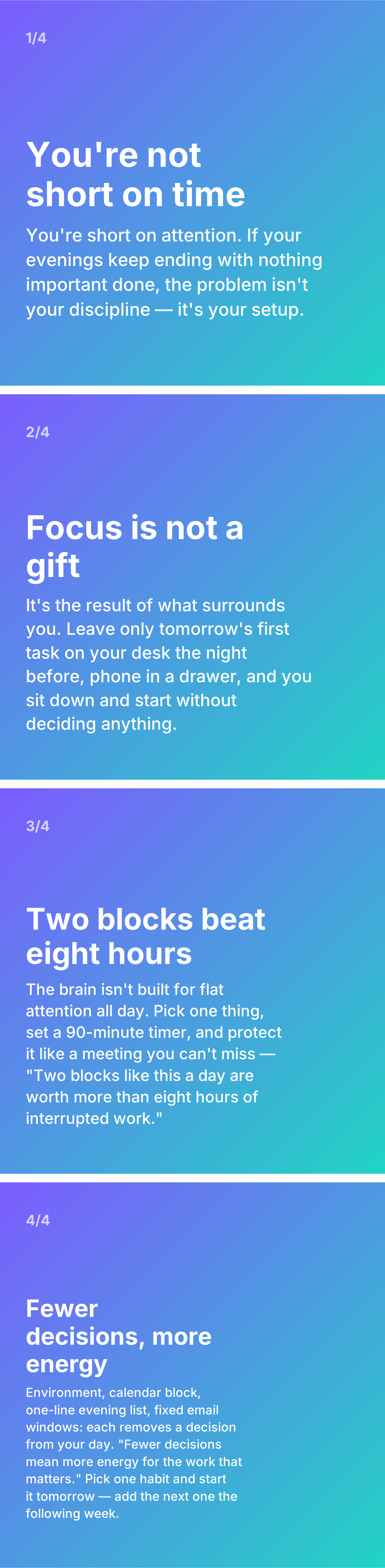
Focus is not a talent some people are born with. "Focus is not a gift, it is the result of what surrounds you." If distraction sits within reach, sooner or later you will give in; make it hard to reach and you stop having to fight it.
The evening routine takes five minutes. Before you end the day, leave on your desk only what tomorrow's first task requires: the document already open, a sheet of paper for notes, a glass of water. The phone goes in a drawer, or in another room if you can manage it. The next morning you do not have to decide anything — you sit down and start.
## Work in deep blocks of 90 minutes
The brain is not built for eight hours of flat attention. It performs far better in intense cycles followed by a break, which is why deep work is scheduled rather than hoped for.
Pick one single thing, set a 90-minute timer, and protect that block like an appointment you cannot miss. If 90 minutes feels like a lot at first, start with 60 and stretch it gradually. Put the block in your calendar with a precise title — not "work on the project" but "write the first draft of the proposal." When the timer goes off, you stop, even mid-sentence. "Two blocks like this a day are worth more than eight hours of interrupted work."
## Start with the hardest thing
Your mental energy peaks in the morning and drops through the day. Spend those first hours on email and you have used the best part of yourself on tasks anyone could do.
So tackle the thing you are avoiding first, and the rest of the day runs downhill. The mechanism is a single line written on paper the evening before: tomorrow's hardest thing. Not a list of ten items — one line. In the morning, before opening your email, you work on it for the first block. If you finish early, good: the task that weighed the most is already behind you.
## Silence notifications and stay in single tasking
Every notification is an invitation to switch context, and every switch costs you minutes to get back on track. It is not multitasking; it is moving badly from one thing to another. Put the phone in another room, turn off the alerts, and do one thing at a time all the way through.
The first few times you will feel you are missing something. After a few days you will notice that nothing happens. A simple starting point: give email two fixed windows, one at the end of the morning and one in the middle of the afternoon. Outside those windows the inbox stays closed. If something is truly urgent, whoever needs you will call.
## Take real breaks to recover your attention
A break spent scrolling social media recharges nothing. Real breaks are what make focus sustainable — not caffeine. Ten minutes between one block and the next are enough.
What a real break looks like: you stand up, refill your glass of water, take two flights of stairs or a few steps outside, and look at something far away from the window. No phone. After ten minutes you go back to your desk and start the next block with a lighter head.
## Why the habits work better together
Each habit removes one decision. Your environment decides instead of your willpower; the block in your calendar decides when you work; the evening line decides where you start; the email windows decide when you reply. "Fewer decisions mean more energy for the work that matters." And more energy at the end of the day also means more time and a clearer head for the people around you.
The one mistake to avoid is trying all five at once. Pick one habit and put it into practice tomorrow, then add the next one the following week. Small changes repeated every day are what make the difference.
## FAQ
**How long should a deep work block be?**
90 minutes is the target, because the brain performs better in intense cycles followed by a break. If that feels too long at first, start with 60 minutes and stretch it a little at a time.
**What should I do the evening before to focus better in the morning?**
Leave only what you need for tomorrow's first task on your desk, put your phone in a drawer or another room, and write one line on a sheet of paper: tomorrow's hardest thing.
**Do I need an app or a special tool to build these focus habits?**
No. A sheet of paper, a timer and a bit of consistency are enough.
**How many email checks a day should I allow?**
Two fixed windows work well: one at the end of the morning and one in the middle of the afternoon. Outside those windows, keep the inbox closed.
## Start with one habit tomorrow
Design your environment, work in 90-minute blocks, start with the hardest task, silence notifications and take real breaks — but choose just one of them for tomorrow. If this was useful, subscribe to the channel.
Meta description: Build focus habits that work: design your environment, use 90-minute deep work blocks and start with the hardest task.
Subject: You're not short on time, you're short on attention
Preheader: Five focus habits you can start tomorrow, no apps or expensive tools required.
Hi,
If your days end with a full inbox and nothing important actually finished, the problem usually isn't the number of hours you're putting in. As the video puts it: you are not short on time, you are short on attention. The good news is that focus is not a gift, it is the result of what surrounds you, and that means it can be designed.
Start the evening before. Leave only what you need for tomorrow's first task on your desk, phone in a drawer, and write one line: tomorrow's hardest thing. Then protect a 90-minute deep work block in your calendar with a precise title, and spend the first block of the day on that hardest task, before you open your email. Two blocks like this a day are worth more than eight hours of interrupted work. Silence notifications, single-task all the way through, and give email two fixed windows instead of letting it run your morning.
Breaks matter just as much. Ten screen-free minutes between blocks, standing up, moving, looking into the distance, are what make focus sustainable. And don't try all five habits at once: pick one, put it into practice tomorrow, add the next one the following week. Fewer decisions mean more energy for the work that matters.
Watch the full video and choose the habit you'll start with tomorrow.
Talk soon.
Design your environment, don't rely on willpower.
0:29–0:52 · CC
86potential
Offers a practical, counter-intuitive solution to a common problem.
Hook
Completeness
Value
Emotion
Work in 90-minute deep blocks for better focus.
1:16–2:01 · CC
78potential
Provides a specific, actionable method for improving work efficiency.
Hook
Completeness
Value
Emotion
You are not short on time, you are short on attention.
Q: How do I stop relying on willpower to stay focused?
A: Design your environment before you need it. Take your phone off the desk, close unnecessary tabs and prepare everything the evening before, because "Focus is not a gift, it is the result of what surrounds you."
Q: How long should a deep work block be?
A: Work in deep blocks of 90 minutes, protected like an appointment you cannot miss. If 90 minutes feels like too much at first, start with 60 and stretch it a little at a time.
Q: Why is it better to start with the hardest task in the morning?
A: Your mental energy peaks in the morning and drops during the day. Spending the first hours on email uses your best energy on tasks anyone could do, while tackling what you are avoiding makes the rest of the day feel downhill.
Q: How do I stop checking email all day?
A: Give email two fixed windows, one at the end of the morning and one in the middle of the afternoon. Outside those windows your inbox stays closed, and if something is truly urgent, whoever needs you will call.
Q: What should I do during a break to actually recover focus?
A: Stand up, move, look into the distance and breathe — no phone. A break spent scrolling social media recharges nothing, while ten screen-free minutes between blocks are enough to start the next one with a lighter head.
Q: Why do notifications hurt my productivity so much?
A: Every notification is an invitation to switch context, and every switch costs you minutes to get back on track. It is not multitasking, it is moving badly from one thing to another.
Q: Should I try all five focus habits at once?
A: No. Pick one and put it into practice tomorrow, then add the next one the following week. Small changes repeated every day are what make the difference.
Q: What do I need to start these focus habits?
A: No apps or expensive tools. A sheet of paper, a timer and a bit of consistency are enough.
1. What does the speaker say focus actually depends on?
A) The quality of the apps and tools you pay for, since free options rarely hold up.
B) Your surroundings.
C) Your natural talent.
D) Luck and mood.
Answer: B
2. What should you leave on your desk at the end of the day?
A) Notes from the meeting you had that afternoon, so the details stay fresh overnight.
B) Nothing at all.
C) Your calendar.
D) Tomorrow's first task.
Answer: D
3. How long is a deep block, and what happens when the timer goes off?
A) 60 minutes; you extend it by ten minutes each time until you reach two full hours.
B) 45 minutes; you switch to a second task without pausing in between.
C) 90 minutes; you stop.
D) 25 minutes; you rest.
Answer: C
4. Why does the speaker suggest tackling the hardest task first?
A) Mental energy peaks early.
B) Because email and messages are lighter work that benefits from a tired, less analytical mind later on.
C) It builds discipline.
D) It clears the inbox.
Answer: A
5. What does the speaker recommend for email?
A) One long window at the start of the morning, when your energy is highest and replies come fastest.
B) Two fixed windows.
C) Keeping it open all day but replying only to messages marked as urgent by the sender.
D) Never checking it.
Answer: B
6. How should you introduce the five habits?
A) Only after you have bought a timer and a planning app to track your progress.
B) Every other day.
C) In reverse order.
D) One at a time.
Answer: D
Titles:
- You're Not Short on Time, You're Short on Attention
- 5 Focus Habits That Beat Willpower Every Time
- Work 90-Minute Blocks, Not 8-Hour Days
- Stop Relying on Willpower: Design Your Focus Instead
- Working All Day and Getting Nothing Done? Try These 5 Habits
Hooks:
- You're not short on time. You're short on attention.
- Stop relying on willpower and start designing an environment that forces you to focus.
- Do you work all day and reach the evening without finishing anything important? The problem isn't your hours.
Call to action:
- Pick one habit and put it into practice tomorrow — add the next one the following week.
- Subscribe for next week's video on how to say no without feeling guilty.
- Try the evening setup tonight: five minutes, one task, phone in a drawer.
# 5 habits to focus and get more done
## Objectives
- Understand why focus depends on your environment more than on willpower.
- Organise the day in deep blocks of 90 minutes.
- Pick, each evening, the hardest task to tackle first.
- Cut notifications and context switches, and take breaks that really recharge.
## Key concepts
### Design your environment
Focus is not a gift: it is the result of what surrounds you. Before relying on willpower, take your phone off the desk, close the tabs you do not need and prepare everything the evening before. If distraction is within reach, sooner or later you give in; if it is hard to reach, you do not have to fight it.
Example: in the evening, leave on your desk only what you need for tomorrow's first task (the document already open, a sheet of paper for notes, a glass of water) and put your phone in a drawer or another room.
### Deep blocks of 90 minutes
The brain is not built for eight hours of flat attention: it performs better in intense cycles followed by a break. Pick one single thing, set a ninety-minute timer and protect the block like an appointment. If ninety minutes feel like a lot, start with sixty and stretch it a little at a time.
Example: put the block in your calendar like a meeting, with a precise title such as "write the first draft of the proposal"; when the timer goes off you stop, even mid-sentence.
### Start with the hardest thing
Your mental energy peaks in the morning and drops during the day. Spending the first hours on email means using the best part of yourself on tasks anyone could do. Tackling first the thing you are avoiding makes the rest of the day downhill.
Example: the evening before, write a single line on a sheet of paper with tomorrow's hardest thing, and in the morning, before opening your email, work on it for the first block.
### Notifications and single-tasking
Every notification is an invitation to switch context, and every switch costs minutes to get back on track: it is not multitasking, it is moving badly from one thing to another. Phone in another room and alerts off: one thing at a time, all the way through. At first you feel you are missing something; after a few days you notice nothing happens.
Example: give email two fixed windows, one at the end of the morning and one in the middle of the afternoon; outside them your inbox stays closed.
### Real breaks
A break spent scrolling social media recharges nothing. Real breaks, not caffeine, make focus sustainable: stand up, move, look into the distance, breathe. Ten minutes between one block and the next are enough.
Example: stand up, refill your glass of water, take two flights of stairs or a few steps outside, look at something far away from the window, with no phone.
## Steps
1. In the evening, set up your desk for tomorrow's first task and write the hardest thing on a sheet of paper.
2. In the morning, before opening your email, give the first 90-minute block to that task.
3. During the blocks, keep your phone in another room and notifications off.
4. Between blocks, take a real ten-minute break.
5. Open your email only in the two fixed windows of the day.
## Glossary
- **Deep block**: a ninety-minute stretch given to one single thing, protected like an appointment.
- **Single-tasking**: doing one thing at a time, all the way through, without switching context.
- **Real break**: a break that recharges attention because you stand up and move, with no phone.
## Review questions
1. Why is it better to design your environment than to rely on willpower?
2. What can you do if a ninety-minute block feels like too much?
3. Why should the first hours of the day go to the hardest task?
4. What does a single notification cost in attention?
5. Why do these five habits work better together?
1:37 · 4 passages
Through-line: Achieving high-quality work by managing attention and environment rather than just time.
0:00–0:29opening
“Do you feel like you work all day and reach the evening without finishing anything important? You are not short on time. You are short on attention. In this video I will share 5 practical habits to really focus and get more done. Working fewer hours but better. For each one I will give you a practic…”
Defines the problem of attention deficit and sets the practical scope.
1:16–1:41point
“The second habit is to work in deep blocks of 90 minutes. The brain is not built for eight hours of flat attention. It performs much better in intense cycles followed by a break. Pick one single thing. Set a 90 minute timer and protect that block like an appointment you cannot miss…”
Introduces the 90-minute deep work block as a core productivity method.
2:45–3:04point
“Every notification is an invitation to switch context, and every switch costs you minutes to get back on track. It is not multitasking. It is moving badly from one thing to another. Put your phone in another room and turn off the alerts. One thing at a time. All the way through.”
Highlights the cost of context switching and the necessity of single-tasking.
4:10–4:34closing
“Because they take decisions out of your day, your environment decides instead of your willpower, the block in your calendar decides when you work, the evening list decides where you start, the email windows decide when you reply, fewer decisions mean more energy for the work that matters, and more e…”
Summarizes how removing daily decisions preserves energy for meaningful work.
Content indexed for the AI tools (30 passages).
Like what you see?
Upload your own video and get the same assets in minutes.
We respect your privacy
We use cookies and similar technologies. Technical ones are required for the service to work; analytics and marketing ones only with your consent. You can accept, reject or pick categories. More details in our Cookie Policy.